DMV Permit Practice Test 2026
- 4.7
- Rating
- 1.00M
- Installs
- Free
- Price
 Analysis by App-foxy
Preparing for a driving permit can feel strangely difficult: the handbook is full of rules, but reading it from beginning to end does not always show whether I can actually recall them under pressure. DMV Permit Practice Test 2026 takes a more active approach. It is an education app from Astraler that turns permit preparation into repeated question practice, and my overall impression is that it works best as a focused study companion rather than a complete replacement for the official driver handbook.
The app is free to install and is suitable for Everyone, which makes it easy to try before deciding whether it belongs in a longer study routine. It has attracted over 500 thousand installs, with a 4.6 average from around 37 thousand ratings and roughly 6 thousand reviews. Those figures suggest that it has found a useful place for many learners, but they do not remove the need to use it thoughtfully. A practice app can improve recall; it cannot make local traffic rules, road signs, or safe driving habits irrelevant.
How the practice experience helps me study
The main strength is its straightforward purpose. Instead of asking me to search through long pages for a particular rule, it gives me a way to test what I remember. That difference matters because recognition and recall are not the same thing. I may understand a paragraph while reading it, yet hesitate when a question presents several similar answers. Repeated testing exposes that hesitation much faster.
You May Also Like

 Blood Strike: 2.5 Anniversary
Blood Strike’s Loadouts Turn Every Drop Into a Tactical Gamble
A close look at Blood Strike’s custom loadouts: how fast access to signature weapons reshapes its battle royale rhythm, rewards preparation, and narrows the gap between fights.

 Pandora - Music & Podcasts
Pandora’s Music Is Easy to Start, but Harder to Recover
Pandora’s strength is its low-effort path from a seed to a station. Its weak spot is how much confidence it asks you to place in connection, setup, and quiet recovery.

 8 Ball Pool
 Is Built on Rivalries, Rematches, and Routine
A close look at the rivalries, rematches, shared routines, and unanswered safety questions that turn a quick pool match into a persistent mobile community.

 Samsung Music
’s Quiet Strength Is Playing What You Already Own
Its reach comes less from spectacle than from dependable access to a personal library. That simplicity is both the app’s strongest retention engine and its ceiling.

 AccuWeather: Weather Radar
AccuWeather Review: A Quick, Clear Forecast for Everyday Decisions
For everyday plans, the best forecast is the one you can understand quickly. AccuWeather makes rain timing, radar, and local conditions easy to act on, with a few trade-offs.

 Hill Climb Racing
Why Hill Climb Racing Still Turns Crashes Into One More Run
A tiny car, a bumpy hill and one more upgrade: Hill Climb Racing keeps resurfacing because its simple chaos makes every near-miss feel personal.
More From Our News Desk



I found the app most useful in short sessions. A quick round during a break is easier to maintain than promising myself an entire evening with the handbook. After answering, I can use the result as a signal about what deserves another look. If I repeatedly miss questions involving signs, right-of-way, or numbers, I know that passive rereading is not enough. I can return to the relevant section of my state’s official material and then test myself again.
That workflow is more effective than treating every wrong answer as a simple mistake. I recommend keeping a small note on the side with three columns: the topic, the answer I chose, and the rule that corrected me. The app supplies the practice, while the note shows patterns over time. This is particularly helpful when two answers sound reasonable and the distinction depends on wording.
Another useful habit is to avoid rushing through questions simply to produce a high score. A learner can sometimes remember the shape of a question after seeing it several times without truly understanding the rule. I get more value by explaining the answer to myself before moving on. If I cannot explain why the other choices are wrong, I count that question as unfinished even when I selected the correct option.
A realistic study routine for a busy learner
Imagine someone who works during the day and has a permit appointment coming up. A practical routine would be a short session in the morning, a review of missed topics later, and a longer mixed session on a day off. The important part is not the exact schedule; it is separating practice from correction. Answering dozens of questions without reviewing mistakes creates the feeling of progress without necessarily fixing weak areas.
I would begin with untimed practice, because the first goal is understanding. Later, I would answer without looking anything up and mark questions that required guessing. Those guesses matter almost as much as incorrect answers. On a final review day, I would use the app to identify uncertainty, then verify the rule in the official handbook rather than memorizing an isolated sentence.
This approach also helps with test anxiety. Familiarity with question-based studying can make the real permit exam feel less unfamiliar. It does not guarantee a pass, but it gives the learner a clearer sense of which subjects still need work. For a first-time driver, that self-awareness is more valuable than a single impressive practice result.
What makes it more useful than simply rereading a handbook
The app’s value comes from active recall. A handbook is still the authority I would trust for the exact rules in my jurisdiction, but it is not always the easiest tool for discovering what I have forgotten. DMV Permit Practice Test 2026 fills that gap by making weaknesses visible.
It is also less demanding than a full online course. Someone who does not need video lessons, instructor explanations, or a broad curriculum may prefer a direct question-and-answer format. The app gets me into practice quickly, which is a real advantage when I am studying in small pockets of time.
Compared with random web quizzes, a dedicated app is more convenient for maintaining a routine. I do not have to repeatedly search for another test or sort through unrelated pages before beginning. That convenience sounds minor, but reducing setup friction makes it more likely that I will practice consistently.
Still, I would not confuse convenience with completeness. A quiz app can present a rule, but it may not explain the wider context as clearly as an official manual. It also cannot observe how I scan an intersection, judge distance, or respond to an actual road situation. For those skills, supervised driving instruction and real-world practice remain essential.
The limitation that matters most
My biggest reservation is that permit rules are not something I would study from a generic source alone. Requirements and wording can vary by state or jurisdiction, and a practice question may not cover every detail that appears on the real examination. Even when a question feels familiar, I should verify important rules against the current official handbook for the place where I plan to test.
This is not a criticism of practice testing itself; it is a limitation of the format. The app is strongest at rehearsal, not at serving as the final legal reference. Anyone who treats a perfect practice run as proof of complete readiness may be overconfident. I would use it to find gaps, then use official material to close them.
There is also a possible learning trap in repeated question sets. If I see the same wording enough times, I may memorize the answer without being able to apply the underlying rule to a new situation. To avoid that, I deliberately pause and describe the principle in my own words. I also mix topics instead of studying only the easiest category, because the actual test may require switching quickly between signs, safety rules, and traffic laws.
The free entry point is welcome, but the app includes in-app purchases ranging from $0.99 to $29.99 per item. That does not make the app poor value, yet it means I would check what is available without payment before building my entire study plan around it. A learner who only wants basic practice may be satisfied with the free experience, while someone seeking broader access should consider the cost carefully.
Because the current version is 3.4.1 and the minimum requirement is Android 8.0, compatibility should be comfortable for many Android users with reasonably recent devices. I would still keep the app updated and avoid relying on it as my only copy of study material. A stable routine is easier when the official handbook is saved or available separately for checking explanations and local details.
Who should use it, and who should choose something else
I think this app is a good fit for a learner who already has access to the official handbook and wants frequent self-testing. It suits people who prefer short study sessions, need help identifying weak subjects, or lose focus when reading rules passively. It is also useful for a second review after a classroom lesson, because questions can reveal which parts of the lesson did not stick.
Parents helping a teenager prepare may find it useful as a starting point for conversations. Rather than asking, “Did you study today?”, they can ask the learner to explain a missed rule and discuss how it applies on the road. That turns an isolated phone exercise into a safer learning habit.
I would be more cautious about recommending it to someone who has not yet opened the official manual at all. That person may need explanations, local requirements, and a structured overview before practice questions become meaningful. A state-specific course, instructor-led program, or official study guide may be the better first step.
It is also not the right choice for someone looking for behind-the-wheel training. No collection of permit questions can replace supervised practice, feedback from an experienced driver, or professional instruction. Learners who struggle with reading comprehension may benefit more from a resource with audio, visual teaching, or one-to-one support, depending on what is available to them.
Small techniques that improve the results
My first tip is to separate confidence from accuracy. Before revealing an answer, I rate my confidence as high, medium, or low. A correct answer chosen with low confidence becomes a review item, while an incorrect answer with high confidence signals a misunderstanding that deserves special attention.
My second tip is to study the explanation, not just the letter of the answer. When a question concerns a sign or traffic situation, I try to picture where I would look, what hazard might be present, and which action keeps other road users safe. This makes the rule easier to transfer to a differently worded question.
My third tip is to stop a session when concentration drops sharply. Continuing while guessing can train careless habits. A shorter, deliberate session followed by a review of mistakes is more useful than a long streak of automatic taps. The app makes frequent practice easy, but I still have to control the quality of that practice.
One more useful trade-off is deciding when to use the app and when to leave it. If I keep missing a topic, more questions alone may not solve the problem. That is the moment to return to the handbook, ask an instructor, or find a clearer explanation. Practice is a diagnostic tool; it is not always the treatment.
My final assessment
DMV Permit Practice Test 2026 is best viewed as a recall trainer, not a complete driver-education system. In my experience, its direct question-based approach makes studying easier to start and helps expose weak areas that ordinary reading can hide. The free price lowers the barrier to trying it, and the broad user response shows that many learners find the format worthwhile.
My recommendation comes with one firm condition: pair it with the official handbook for your jurisdiction. Use the app to rehearse, track uncertainty, and build confidence, but verify rules and requirements through authoritative material. That combination gives the app a clear role without asking it to do a job it was not designed to do.
Astraler has made a practical education app for people who need repeated permit-test practice rather than another long explanation. I would recommend it to focused learners who want a convenient study companion and are willing to review their mistakes honestly. I would skip relying on it alone if I needed local legal guidance, detailed teaching, accessibility support, or actual driving instruction. Used with those boundaries in mind, it is a sensible free starting point for a more disciplined permit-preparation routine.
FAQs for DMV Permit Practice Test 2026
01What is DMV Permit Practice Test 2026?
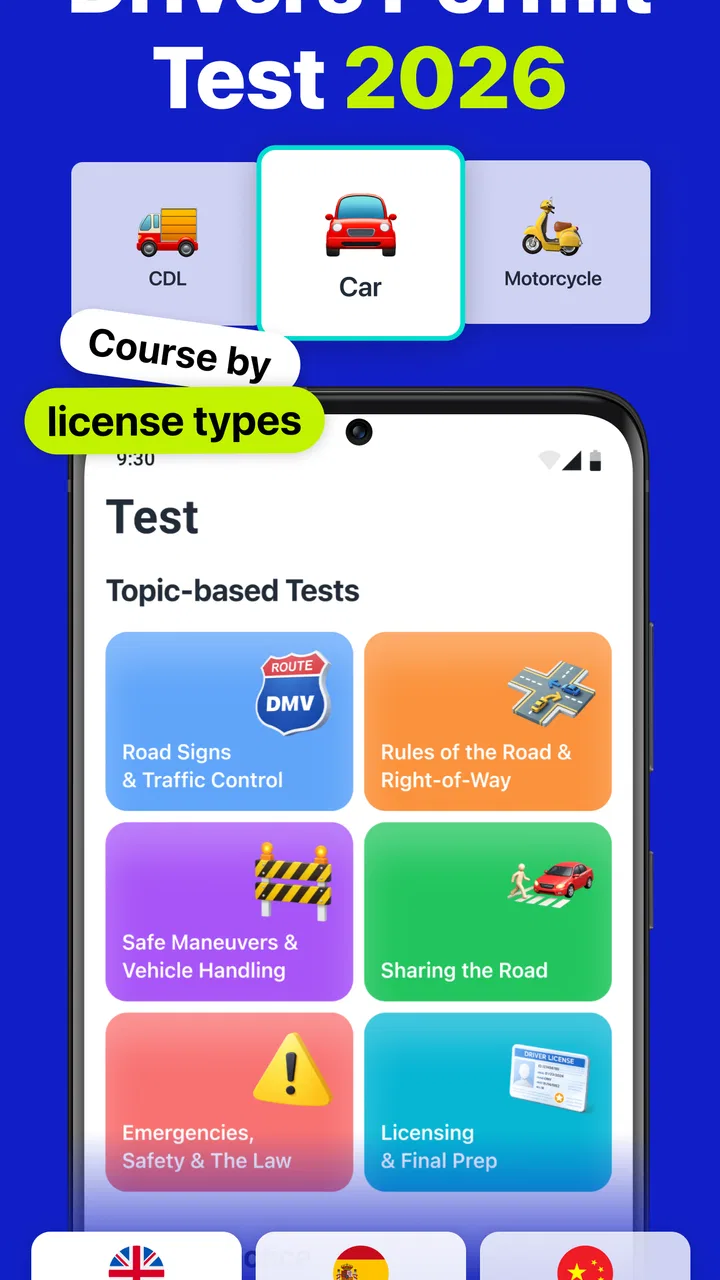
DMV Permit Practice Test 2026 is a mobile application designed to help users prepare for their driver's permit exam. It offers a wide array of practice tests, covering various topics such as road signs, traffic laws, and safe driving practices. The app aims to enhance your knowledge and confidence before taking the actual permit test.
02How accurate are the practice questions in DMV Permit Practice Test 2026?
The practice questions in DMV Permit Practice Test 2026 are crafted to closely mirror the actual questions found on the DMV permit test. They are regularly updated to reflect the most recent laws and regulations. Users have often reported that the practice questions are highly representative of the real test questions.
03Does DMV Permit Practice Test 2026 cover tests for all states?
Yes, DMV Permit Practice Test 2026 offers practice tests tailored for each state in the U.S. This ensures that users can study the specific rules and regulations relevant to their location. The app provides an option to select your state when you first set it up, tailoring the content accordingly.
04Is DMV Permit Practice Test 2026 suitable for all age groups?
While DMV Permit Practice Test 2026 is primarily designed for new drivers aiming to get their permit, it is suitable for anyone looking to refresh their driving knowledge. It can be particularly beneficial for teens and young adults, but older individuals retaking their test or updating their knowledge can also find it useful.
05Are there any costs associated with using DMV Permit Practice Test 2026?
DMV Permit Practice Test 2026 is free to download and use, offering a range of practice tests at no cost. However, there may be in-app purchases available for users who wish to access additional features or remove ads. It’s advisable to check the app’s store page for the most current pricing details.
Pros
- Comprehensive question database.
- User-friendly interface design.
- Offline mode available.
- Regular updates for accuracy.
- Customizable test options.
Cons
- Limited free content.
- Ads can be intrusive.
- No progress tracking feature.
- Requires internet for updates.
- Limited language options.

DMV Permit Practice Test 2026
Gallery